- Contextualizing the Data Divide
- Unlocking Enterprise Data for AI/ML
- Preserving Data Gravity and Governance
- Operational Simplicity and Cost Efficiency
- Forward-Looking Implications
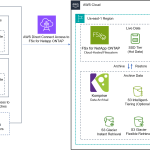
Amazon Web Services (AWS) recently announced a pivotal integration, enabling Amazon FSx for NetApp ONTAP to seamlessly access Amazon S3 data. This development, rolling out across AWS regions, directly addresses the persistent challenge of leveraging enterprise file data for advanced Artificial Intelligence (AI) and Machine Learning (ML) workloads and analytics, allowing data to remain within its native file system while becoming accessible to services like Bedrock and SageMaker.
Contextualizing the Data Divide
For years, enterprises have grappled with a fundamental architectural divide: the distinct paradigms of file storage and object storage. Amazon FSx for NetApp ONTAP offers fully managed, high-performance file storage, replicating the feature-rich capabilities of on-premises NetApp ONTAP systems, including snapshots, replication, and data efficiency features. It excels in traditional enterprise applications requiring POSIX compliance and low-latency file access.
Conversely, Amazon S3 provides highly scalable, durable, and cost-effective object storage, serving as the de facto standard for data lakes, cloud-native applications, and archiving. Its inherent scalability and API-driven access make it ideal for modern analytics and AI/ML pipelines, which often operate on vast datasets.
The challenge has been effectively bridging these two worlds. Enterprise file data, often residing in FSx for ONTAP for compliance, performance, or legacy reasons, frequently needed complex, costly, and time-consuming Extract, Transform, Load (ETL) processes or data duplication to become usable by S3-centric AI/ML and analytics services. This friction hindered innovation and increased operational overhead.
Unlocking Enterprise Data for AI/ML
The new integration fundamentally alters this dynamic. It allows S3 clients to directly access data residing within Amazon FSx for NetApp ONTAP file systems without requiring data migration or synchronization. This is not a data copy operation; rather, it establishes a direct access pathway, presenting file data as objects to S3-compatible applications.
This capability holds significant implications for AI/ML initiatives. Enterprises can now point their AI/ML models, developed in Amazon SageMaker, or generative AI applications, powered by Amazon Bedrock, directly at their existing enterprise file data. Consider sectors like healthcare, where vast amounts of medical imaging (DICOM files) are stored in file systems, or manufacturing, with complex CAD files and sensor data. Previously, making this data accessible to AI required significant engineering effort; now, it becomes a direct input.
Furthermore, the integration extends to other analytics services within AWS, offering a unified approach to data access. This significantly reduces the time-to-insight for data scientists and analysts, enabling them to work with authoritative, real-time enterprise data without the latency and complexity associated with data movement.
Preserving Data Gravity and Governance
A critical aspect of this integration is its respect for data gravity and governance. By allowing data to remain within FSx for ONTAP, organizations continue to leverage ONTAP’s robust data management features. This includes granular access controls, snapshots for rapid recovery, replication for disaster recovery, and data efficiency capabilities like deduplication and compression.
For industries with stringent regulatory requirements, such as finance and government, maintaining data within a managed file system with established governance policies is paramount. This integration ensures that data exposure to AI/ML workloads adheres to existing security and compliance frameworks, mitigating risks associated with data sprawl or unauthorized duplication. It centralizes data management, simplifying audits and ensuring data integrity.
Industry observations consistently highlight data silos as a major impediment to AI adoption. This integration directly dismantles one such silo, providing a more cohesive data fabric within the AWS ecosystem. Analyst firm Gartner frequently emphasizes the need for platforms that unify data access across diverse storage types to accelerate digital transformation initiatives.
Operational Simplicity and Cost Efficiency
Beyond technical capabilities, the integration offers substantial operational and cost benefits. Eliminating the need for complex ETL pipelines and data replication between file and object storage streamlines data operations. Data engineers can focus on building innovative applications rather than managing data synchronization tasks.
Cost efficiency arises from several factors. Avoiding data duplication reduces storage costs, as only one authoritative copy of the data needs to be maintained. Furthermore, it minimizes egress charges often incurred when moving large datasets between different storage services or regions. This simplified architecture translates directly into lower total cost of ownership (TCO) for data-intensive workloads.
Forward-Looking Implications
This integration marks a significant step towards a more unified and intelligent data architecture in the cloud. It signals a broader trend where cloud providers will increasingly focus on blurring the lines between different storage paradigms, enabling seamless data access regardless of its underlying format or location. Enterprises should anticipate further innovations that simplify data access for emerging technologies, especially as generative AI and advanced analytics become more pervasive across business functions.
The ability to effortlessly connect enterprise file data to cutting-edge AI services without compromising data governance or incurring significant operational overhead will accelerate AI adoption and unlock new value from previously underutilized datasets. Organizations should evaluate how this integration can streamline their existing data pipelines, enable new AI/ML use cases, and optimize their cloud storage strategies in the coming months.