- The Imperative of Adaptive Experimentation
- Ax 1.0: An ML-Driven Optimization Engine
- Data-Driven Efficiency and Broader Impact
- Forward Outlook: The Future of Automated Optimization
Meta’s engineering division recently announced the public release of Ax 1.0, an open-source platform designed to streamline and optimize complex, resource-intensive experimentation. This pivotal development, detailed in an accompanying paper, leverages machine learning to automatically guide processes ranging from AI model tuning and production infrastructure optimization to accelerating advancements in machine learning research and hardware design.
The Imperative of Adaptive Experimentation
In the rapidly evolving landscape of artificial intelligence and large-scale computing, the efficiency of experimentation directly impacts innovation speed. Traditional trial-and-error methods for optimizing complex systems, such as training sophisticated AI models or fine-tuning vast data center infrastructures, often prove prohibitively time-consuming and resource-intensive.
These challenges typically involve navigating high-dimensional parameter spaces, where finding optimal configurations requires numerous iterations. Without intelligent guidance, such processes consume significant computational power and human effort, often leading to suboptimal outcomes or missed opportunities for performance gains.
Ax 1.0: An ML-Driven Optimization Engine
Ax 1.0 addresses these inefficiencies by employing advanced machine learning algorithms to intelligently explore experimental spaces. Instead of exhaustive searches, Ax builds a statistical model of the objective function, predicting the performance of unseen parameter combinations. This allows the platform to suggest the most promising next experiments, drastically reducing the number of trials required.
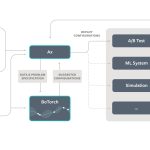
The platform’s architecture, as outlined by Meta in its accompanying paper, supports diverse experimentation paradigms, including Bayesian Optimization, multi-armed bandits, and evolutionary algorithms. This versatility enables its application across a broad spectrum of use cases, from optimizing hyper-parameters in deep neural networks to fine-tuning system configurations for energy efficiency.
Internally, Meta has deployed Ax at an unprecedented scale. The platform underpins critical operations, enhancing the performance of AI recommendation systems, optimizing resource allocation within its vast data centers, and even accelerating the design cycles for custom hardware components. Its success within Meta’s demanding ecosystem validates its robustness and efficacy.
The decision to open-source Ax 1.0 marks a significant contribution to the broader tech community. By making this sophisticated optimization tool freely available, Meta democratizes access to advanced ML-guided experimentation. This move fosters collaboration, encourages external contributions, and potentially accelerates innovation across various industries, providing researchers and developers with a powerful tool previously confined to large, well-resourced organizations.
Data-Driven Efficiency and Broader Impact
Meta’s accompanying paper, “Ax: A Platform for Adaptive Experimentation,” elaborates on the statistical methodologies and performance gains achieved through Ax. While specific public benchmarks for Ax 1.0 are emerging, Meta’s internal deployment demonstrates substantial efficiency improvements in various domains. For instance, optimizing complex AI models can see significant reductions in training time and computational cost, directly translating into faster model iteration and deployment.
The platform’s design emphasizes flexibility and extensibility, allowing users to integrate Ax with their existing experimental infrastructure. This adaptability is crucial for its adoption across diverse engineering environments, from startups to large enterprises. The open-source nature also invites the community to build upon its foundation, further extending its capabilities and applications beyond Meta’s initial scope.
Forward Outlook: The Future of Automated Optimization
The release of Ax 1.0 signals a critical shift towards more automated and intelligent approaches to scientific and engineering experimentation. For developers and researchers, it promises to democratize access to advanced optimization techniques, enabling more efficient resource utilization and faster discovery cycles. This could significantly lower the barrier to entry for developing high-performance AI systems and complex software solutions.
Industries reliant on data-intensive processes, including pharmaceuticals, manufacturing, and financial modeling, stand to benefit immensely. The ability to rapidly optimize complex systems using ML-guided methods could lead to breakthroughs in product development, operational efficiency, and scientific discovery. Furthermore, Ax’s open-source model could catalyze the development of a new ecosystem of tools and services built around adaptive experimentation.
As the platform matures with community contributions, its impact on the speed and efficacy of technological advancement could be profound. Observers should watch for widespread adoption across various sectors, new integration patterns with existing ML frameworks, and the emergence of specialized extensions that tailor Ax’s power to niche applications. This marks a significant step towards a future where intelligent systems not only solve problems but also efficiently discover the best ways to solve them.