- Context: A Concentrated Market’s Unforgiving Grip
- The Struggle for Alpha: When Deviation Proved Costly
- Expert Perspectives and Supporting Data
- Implications: Reshaping the Investment Landscape
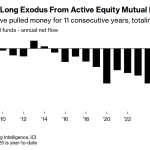
Investors worldwide faced unprecedented challenges in the past year, prompting a significant trillion-dollar exodus from active fund management into passive investment vehicles. This substantial shift, observed across major financial markets, is primarily attributed to the overwhelming market dominance of a select few technology giants, which rendered traditional stock-picking strategies largely ineffective and costly for those attempting to deviate from benchmark indices.
Context: A Concentrated Market’s Unforgiving Grip
The backdrop to this industry upheaval is a market environment characterized by extreme concentration. Throughout the recent period, a handful of mega-cap technology companies disproportionately drove overall market gains. Their innovative products, expansive global reach, and robust business models, often accelerated by pandemic-era trends, solidified their market positions and led to extraordinary growth.
This phenomenon created an exceptionally challenging landscape for active fund managers. To keep pace with the broader market and avoid significant underperformance, many managers were effectively compelled to hold substantial positions in these dominant tech stocks. This reduced their ability to express unique investment theses or find alpha outside of these heavily weighted constituents, blurring the lines between truly active and quasi-passive strategies.
The Struggle for Alpha: When Deviation Proved Costly
For active managers, the year presented a stark choice: conform to the market’s concentration or risk being left behind. Market data indicates that funds which attempted to diversify away from the leading tech names or underweight them experienced substantial underperformance. This deviation proved costly, directly impacting investor returns and confidence, and challenging the very premise of active management.
The conventional wisdom—that skilled managers can identify mispriced assets and outperform the market—was severely tested. When a significant portion of market returns is generated by a very narrow segment, the opportunity set for traditional stock picking diminishes dramatically. This dynamic created immense pressure on active funds to justify their often-higher fees, especially when their performance lagged benchmark indices.
Consequently, the flow of capital witnessed a dramatic reorientation. Industry reports confirm a net outflow of over a trillion dollars from active funds globally, mirroring a corresponding inflow into passive investment vehicles, such as exchange-traded funds (ETFs) and index funds. This capital migration underscores a growing investor preference for low-cost, market-tracking solutions in an environment where consistent active outperformance became an elusive goal for a vast majority of managers.
Expert Perspectives and Supporting Data
Financial analysts and market strategists widely acknowledge the structural challenges posed by current market dynamics. Data from leading financial institutions highlights that the top five to ten companies accounted for an unusually high percentage of the S&P 500’s total return over the past year. This level of concentration has not been seen in decades, outside of specific bubble periods, prompting concerns about market breadth and sustainability.
Investment bank reports suggest that even top-quartile active managers struggled to beat their benchmarks, with a significant majority trailing their respective indices. This performance gap is a critical factor driving investor decisions, as the value proposition of paying higher management fees for underperformance becomes increasingly untenable. Fund flow data from major custodians and research firms provides concrete evidence of this trend, showing consistent quarterly outflows from actively managed equity funds across both institutional and retail segments.
Economists point to the ‘winner-take-all’ nature of modern digital economies as a contributing factor. Network effects and economies of scale allow a few dominant players to capture vast market share, creating moats that are difficult for competitors, and by extension, active managers, to overcome or exploit for alpha generation.
Implications: Reshaping the Investment Landscape
The implications of this trillion-dollar shift are profound and far-reaching, signaling a potential paradigm shift in the investment management industry. For individual investors, it reinforces the appeal of passive investing as a cost-effective and often more reliable method for capturing broad market returns, especially in highly concentrated markets where diversification benefits are limited by dominant players.
For active fund managers and asset management firms, this trend necessitates a critical re-evaluation of their strategies, fee structures, and value proposition. The pressure to innovate and demonstrate genuine alpha generation outside of market-dominant themes will intensify. Many firms are exploring pivots towards more specialized, niche strategies where active management can still add significant value, such as in less efficient markets, private equity, or specific alternative asset classes like venture capital or impact investing.
Furthermore, the role of financial advisors may evolve, shifting from selecting individual active funds to constructing diversified portfolios that strategically blend passive core holdings with targeted active satellite investments. This approach seeks to balance cost efficiency with opportunities for specialized alpha. The ongoing debate about market efficiency versus the potential for active outperformance will continue to shape product development and investor education.
Looking ahead, the investment landscape will likely continue to evolve under the influence of market concentration and technological advancements. Regulators may also scrutinize the implications of such concentrated market power for competition and systemic risk. Investors should monitor whether market breadth improves, allowing a wider array of companies to contribute to overall market gains, or if the dominance of a few tech giants persists, further cementing the role of passive investing as the default choice for many and compelling active managers to redefine their purpose.